Top 10 Places to Visit in Shimla in 2026: A Lived-In Guide
Top 10 Places to Visit in Shimla in 2026: A Lived-In Guide to the Queen of Hills
The First Breath of Cedar: A Shifting Mist
There is a specific moment, usually around Barog, where the air changes. It loses the heavy, humid weight of the plains and takes on the sharp, resinous scent of cedar and aged pine. As I leaned my head out of the narrow window of the Kalka-Shimla Toy Train—my fingers cold against the green-painted metal—I realized that despite all the tourists, Shimla in 2026 still holds a secret resonance.
I arrived at the Shimla station at 11:30 AM. The station itself is a UNESCO-recognized portal back to 1903. The wooden beams, the vintage clocks, and the porters in their red vests haven't changed much, but the vibe of the city has. After the chaotic rush of 2024, Shimla has settled into a "Quiet Luxury" era. Most of our Shimla Classic Tours now focus on this slower pace.
If you are planning your escape to the 'Queen of Hills' this year, don't just follow a map. Follow the mist. Here is my firsthand account of the ten places that defined my Shimla experience in 2026.
---
1. The Ridge: Shimla’s Grand, Open Stage
The Ridge is more than a geographic center; it is the soul of the town. When I walked up from the lower bazaar, breathless from the incline, the Ridge opened up like a grand theatre. In 2026, the local administration has restricted all commercial stalls to the periphery, leaving the central cobblestone vast and empty for pedestrians.
Standing there at 5:30 PM, I watched the sun dip behind the peaks of the Seven Hills. The sky turned a bruised purple, and the lights of the town began to twinkle like a fallen constellation.
My Insider Tip: Most people take photos of the Christ Church. Instead, walk to the northern edge where the wooden benches are. Below you lies the water reservoir that has supplied Shimla since the British era. It’s a feat of Victorian engineering that most tourists walk right over without knowing.
2. Mall Road: The Beating Heart of the Hills
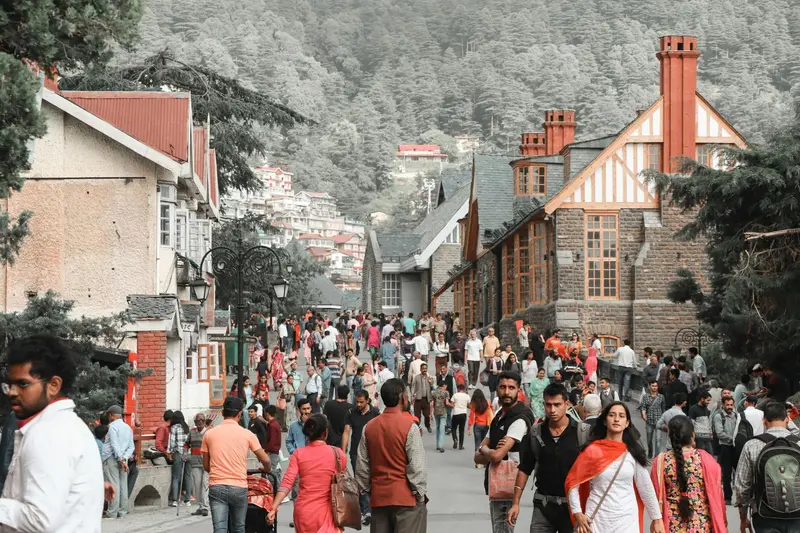
Mall Road is where the pulse of Shimla is most rhythmic. In 2026, the strictly enforced "No Car Zone" has made it one of the most peaceful urban walking experiences in India. I spent my second afternoon here, wandering.
I found myself at a small, unnamed leather shop tucked between two larger showrooms. An old man, his eyes hidden behind thick glasses, was hand-stitching a pair of traditional Himachali *pullahs* (straw slippers). We spoke for twenty minutes about how the leather trade has changed. He told me, "In Shimla, we don't count time by the clock, we count it by the seasons of the cedar."
Dining Note: Skip the overpriced "Multicuisine" restaurants for a moment. Find the small corner stalls selling *Siddu*—a local steamed bread stuffed with poppy seeds and served with a big dollop of desi ghee. It’s the taste of a Himachali winter.
3. Christ Church: Stained Glass and Silent Echoes
The yellow silhouette of Christ Church is synonymous with Shimla. But most people only see the outside. I stepped inside during a quiet Tuesday afternoon. The noise of the tourists outside vanished instantly.
Built in 1857, the church houses some of the most stunning neo-Gothic stained glass windows in Asia. I sat in one of the rear pews, watching the dust motes dance in the light passing through a window depicting "Faith." The coolness of the stone walls seems to absorb the history of the countless travelers who have sought refuge here.
4. Jakhoo Hill & Temple: The High Guardian
Jakhoo is the highest point in Shimla, and getting there is a rite of passage. I decided to walk up from the Ridge rather than taking the ropeway. My lungs burned, and I had to keep a death-grip on my spectacles—Shimla’s monkeys are legendary for their "shakedown" tactics. They will take your glasses and only return them if you offer a packet of Frooti or roasted grams.
At the summit, the 108-foot statue of Lord Hanuman looms over the trees, painted a vibrant saffron. In 2026, the temple complex has been beautifully renovated with local stone carvings. As I stood at the base of the statue, the wind was fierce, and the views of the Shivalik range were unobstructed. It felt like standing on the roof of the world.
5. Viceregal Lodge: Where History was Written
I caught a local HRTC bus from the main stand—costing me a mere 10 rupees—to the Indian Institute of Advanced Study, formerly the Viceregal Lodge. This building is a Jacobian masterpiece. Walking through its teak-paneled hallways, I felt the weight of the 1945 Simla Conference.
In 2026, the guided tours have been expanded to include the "Radcliffe Room," where the maps of modern India and Pakistan were drafted. The manicured lawns and the rare botanical species in the garden are a testament to the scientific rigor the British brought to their summer capital.
6. Kufri: Beyond the Tourist Traps
Kufri is often dismissed as a "tourist trap" filled with horse-dung and overpriced yak rides. But in 2026, a new set of eco-trails has opened up for those willing to walk. I skipped the main "Fun World" area and headed towards the Himalayan Nature Park. Our Himachal Family Holiday includes a curated Kufri experience that avoids the main crowds.
Inside, I was lucky enough to see the elusive Himalayan Monal and a Snow Leopard that had been brought in for rehabilitation. The quietude of the deodar forests here is incomparable. I found a small clearing where I sat for an hour, listening to nothing but the wind whistling through the pine needles.
7. Green Valley: The Infinite Frame
Between Shimla and Kufri lies this dense emerald basin. There’s no "entrance" to Green Valley; it’s a viewpoint on the highway. I stopped here at 4:30 PM, the "Golden Hour." The valley was a sea of undulating green, with small cottage roofs peeking through the canopy like red mushrooms. For any photographer, this is the literal definition of Shimla’s majesty.
8. Chadwick Falls: The Hidden Descent
Located in the Glen Forest, Chadwick Falls is 2026’s best-kept secret for nature lovers. I descended a steep, muddy trail through a canopy that blocked out the sun. The sound of water precedes the view—a 100-meter drop that looks like a bridal veil. It’s best visited right after the monsoon (late September) when the flow is thunderous.
9. Shimla State Museum: The Vault of Pahari Art
As an art lover, this was my sanctuary. Housed in a colonial building atop Mount Pleasant, the museum is home to a world-class collection of Pahari Miniature Paintings. In 2026, they’ve added an interactive section on the "Ganges Canal" architecture. It’s a quiet, scholarly place that offers a deep context to the beauty you see outside.
10. Tara Devi Temple: The Spiritual Summit
I saved Tara Devi for my final day. It’s situated on a hilltop that offers a 360-degree view of Shimla. I took the toy train back down to the Tara Devi station and trekked 4km uphill through a serene oak forest. The temple, dedicated to the Goddess of Stars, feels light-years away from the commercialism of Mall Road. As the temple bells rang for the evening aarti, I felt a profound sense of closure to my journey.
The Taste of the Hills: A 2026 Food Journey
One cannot understand Shimla without tasting it. In 2026, the food scene has moved away from generic "Continental" platters and returned to its roots.
Sita Ram & Sons: The Morning Ritual
Located in the bustling Lakkar Bazaar, Sita Ram & Sons has been serving the same Chole Bhature for generations. But in 2026, they’ve perfected a "Tak-a-Tak" technique that makes the bhature lighter and crisper. I stood in line for 15 minutes at 8:30 AM, watching the steam rise from the large brass pots. The chole are not just spicy; they are deeply flavorful, cooked with a secret blend of local hill spices. It’s a messy, glorious breakfast that costs less than a cup of coffee at a fancy café.
Cafe Simla Times: The Sunset View
For a more relaxed vibe, I headed to Cafe Simla Times. It’s perched on the edge of a cliff with a view that spans the entire valley. In 2026, they’ve introduced a "Foraged Mushroom" pizza, using guchhi (morels) found in the nearby forests of Mashobra. Sitting there with a wood-fired pizza, watching the sky turn from orange to a deep indigo, I felt the true "Slow Travel" magic of 2026.
Street Secrets: The Siddu Crawl
As evening falls, the Lakkar Bazaar smells of roasting grain. I found a small stall run by a woman from the Kullu Valley. She was steaming *Siddu*—a traditional bread made from fermented wheat. I chose the walnut and poppy seed filling. When she cut it open and drizzled a generous amount of melted desi ghee over it, the aroma was intoxicating. It’s the ultimate comfort food for a chilly Shimla night.
---
The Perfect 2026 Three-Day Itinerary
If you only have seventy-two hours, here is how I would guide you to spend them.
Day 1: The Colonial Footprint
Day 2: The High Trails & Spirtual Summits
Day 3: The Hidden Waters & The Stars
---
The Logistics of 2026: How I Made it Happen
Getting There: The Kalka-Shimla Connection
Don't listen to those who say "just take a cab." The Kalka-Shimla Toy Train is the only way to experience the transition of terrain. I booked the Shivalik Deluxe Express (Train 52451) through the IRCTC portal exactly 29 days in advance.
Road and Bus Logistics
If you’re coming from Delhi, the HRTC Himsuta AC Volvo is your best bet.
Where to Stay: Vetted 2026 Choice
I stayed at Vatsalyam Home Stay. It’s located slightly away from the Ridge, but that’s the point. The owner, a local who knows every trail in the Glen, served me homemade *Sepu Vadi* and taught me how to identify different types of pine trees. For a boutique experience, Nau Nabh Cottage is unbeatable for its colonial library and vintage fireplaces.
---
The Traveler’s Toolkit: Survival & Respect
Final Thought
Shimla is not a destination; it's an era. As I sat on the Toy Train heading back down to the plains, watching the red roofs fade into the mist, I realized that the "Queen of Hills" doesn't demand your attention—she commands your stillness. In 2026, she is waiting for you to stop rushing and start seeing.
*Explore the complete circuit: Shimla Manali Classic Itinerary or the Spiritual Temple Trail Guide.*