Spiti Valley Road Trip: Complete Guide for Beginners
Into the Middle Land: The Ultimate Spiti Valley Road Trip Guide (2026 Edition)
1. The Threshold of the Trans-Himalayas: The Brown Void
In 2026, Spiti Valley remains India’s most rugged frontier. But it’s no longer just a destination for the "hardcore" adventurer. It has become a sanctuary for those looking to disconnect from a world that is increasingly loud and digital. As I crossed the Spiti River at the confluence of the Satluj, I felt my phone’s signal bars flicker and then vanish—a ritualistic goodbye to the 21st century.
*Experience the gateway:* Our Shimla-Kinnaur Expedition is the definitive way to approach the cold desert.
If you are a beginner planning your first "Spiti Expedition," let me tell you: the road will test your grit, your patience, and your suspension. But it will also give you something that no five-star resort can—the realization that you are very small, and the world is very, very old.
---
2. Why Spiti in 2026? The "Quiet Desert" Vibe
Let's talk about the vibe. 2024 and 2025 saw a massive surge in "Instagram tourism" that momentarily clouded the soul of the valley. In 2026, however, the local administration and the Spiti Ecosphere (a pioneering social enterprise) have successfully implemented a "Quiet Desert" initiative.
The focus has shifted from "fast travel" to "slow living." Travelers are now encouraged to spend more nights in fewer villages, rather than rushing through Kaza in a three-day whirlwind. Homestays have been upgraded with sustainable heating systems using local mud-brick architecture, and the "Slow Food" movement has brought ancient grains like *Tsampa* (roasted barley) and *Shia-Spiti* (local tea) back to the forefront.
When you enter Spiti in 2026, you aren't just visiting a place; you are entering a protected cultural ecosystem. Connectivity is still a gamble (and honestly, that’s the best part), but the quality of human interaction has never been richer.
---
3. The Golden Rule of Acclimatization: The Shimla-Kinnaur Route
If you take only one piece of advice from my journey, let it be this: Earn your altitude.
Most beginners make the mistake of driving straight from Manali to Kaza via the Atal Tunnel. In 2026, the tunnel makes this "shortcut" tempting, but jumping from 2,000m to 3,800m in a few hours is a recipe for Acute Mountain Sickness (AMS). Your body needs to manufacture red blood cells to survive the thin air, and that process requires a slow, gradient-style ascent.
My journey followed the 700-km "Spiti Circuit," entering via Shimla and exiting via Manali. This 10-day loop allows your lungs to adapt as you climb.
Stop 1: Narkanda – The Cherry Orchard Haven (Day 1)
I started at 8:30 AM from Shimla, leaving the "Queen of Hills" to the weekend crowds. By 11:30 AM, I reached Narkanda (2,708m). I stayed at the *Aarya Homestay*, a beautiful wooden cottage surrounded by cherry and apple orchards.
The highlight? The trek to Hatu Peak. I reached the summit just as the sun was setting behind the Shivalik range. The air was cool, the wind smelled of pine, and I caught my first glimpse of the snowy "Inner Himalayas" on the horizon. This was my body’s first test at 3,400 meters, and I slept like a baby, fueled by a dinner of local *Siddu* with desi ghee.
Stop 2: Kalpa – Living with the Gods (Day 2)
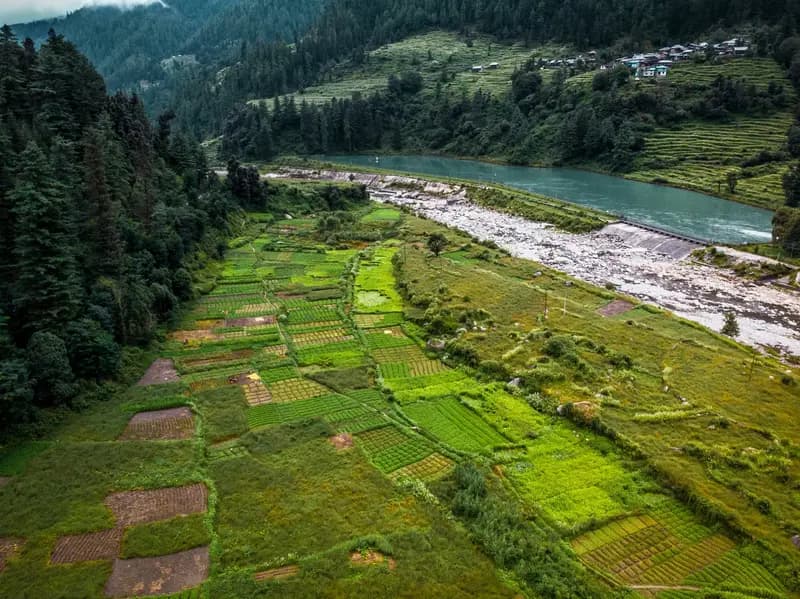
The drive from Narkanda to Kalpa (2,960m) is where the Hindustan-Tibet Highway (NH-5) reveals its true character. The road is literally carved out of vertical cliffs, with the Satluj River roaring thousands of feet below.
Kalpa is where the spirit of the journey changes. You are looking directly at the Kinner Kailash range. The massive 6,050m peak looms so close you feel you can touch the glaciers. I spent my evening at the *Grand View Homestay*, sitting on the balcony and watching the moon light up the Shivling-shaped peak of the mountain. In Kinnauri legend, the peak changes color throughout the day, and at night, it glows with a spectral, silver light.
Pro-Tip: Spend an extra day in Kalpa if you can. Visit the Roghi Village and stand at the "Suicide Point" (the name is dramatic, but the cliff drop is real). It’s the perfect way to get used to the "mountain heart" before you hit the desert.
Stop 3: Nako – The Willow-Shaded Guardian (Day 3)
As we pushed further past Pooh, the landscape finally surrendered. The last of the cedars disappeared, replaced by jagged, wind-sculpted rock. We reached Nako (3,660m) by late afternoon.
Nako is a high-altitude oasis. It has a sacred lake surrounded by willow and poplar trees, tucked into a corner of the Kinnaur-Spiti border. I stayed at a small guesthouse near the Nako Monastery, which dates back to 1025 AD. The village is a maze of stone pathways and low-roofed houses where old women sit spinning prayer wheels.
Survival Note: This is where the altitude starts to get serious. I felt a mild headache behind my eyes—the first sign of the thin air. I drank three liters of water and skipped the evening beer. In the mountains, your "first night high" is for rest, not celebration.
---
4. The 1000-Year Silence: Tabo and Dhankar
Crossing the Sumdo Checkpost is the literal threshold of Spiti. This is where my ID was checked, and we officially entered the Lahaul and Spiti district. The transition was absolute. We were now in the "Valley of Monasteries."
Tabo: The Ajanta of the Himalayas
I arrived in Tabo (3,280m) just as the evening shadows were stretching across the mud-brick village. Tabo Monastery is a UNESCO World Heritage site and the oldest continuously operating Buddhist monastery in India.
Unlike the colorful, tiered monasteries of Ladakh, Tabo is a collection of nine temples made entirely of mud. Inside the Tsuglakkhang (Main Temple), the silence is thick. There is no electricity inside; my monk-guide used a small torch to illuminate the murals. These paintings, created over a thousand years ago, depict the life of the Buddha with a level of detail that is staggering given the primitive tools used.
Standing there in the darkness, surrounded by the faces of a thousand-year-old assembly of deities, I felt a profound sense of temporal displacement. Time in Spiti isn't measured in minutes; it’s measured in centuries.
---
5. The Heart of the Void: Kaza and the High Villages
As my SUV rolled into the dusty, prayer-flag adorned streets of Kaza (3,800m), I felt like I had reached the capital of another world. In 2026, Kaza has balanced its growth with heritage. The main market area now has a "Pedestrian-Only" block where you can sit and watch the giant prayer wheel turn while sipping a cup of sea-buckthorn juice.
I stayed at a homestay in the Old Kaza area, where the mud walls were three feet thick, keeping the inside cool in the fierce high-altitude sun. The hospitality here is not a business; it’s a culture. My host, a local named Tenzin, spent the evening teaching me how to fold *Mokthuks* (momos served in soup) and shared stories of the winters where the temperatures drop to -30°C.
Key Monastery: The Cloud Fortress
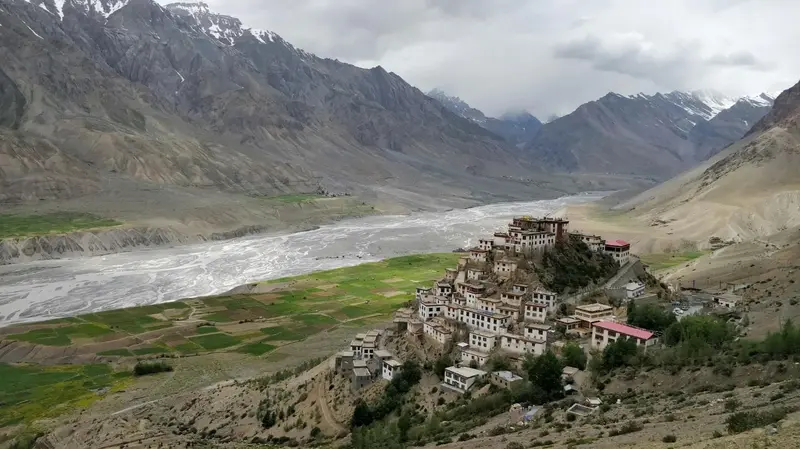
On Day 5, I reached the iconic Key Monastery. Perched on a conical hill, this fortress-like cluster of white and red boxes looks like it was stacked by a deity. I arrived at 7:30 AM to witness the morning chanting. Entering the "Dukhang" (assembly hall) was a sensory overload—the smell of juniper incense, the low vibration of the *dung-chen* (long horns), and the ancient thangkas watching from the shadows.
Pro-Tip: If you ask the monks politely, they might show you the high-altitude library where 1,000-year-old manuscripts are stored in silk-wrapped bundles.
Hikkim: Postcards from the World's Highest Post Office (4,400m)
15 km from Kaza lies Hikkim. In 2026, this post office is still a local legend. I spent an hour here, writing postcards to friends. The postmaster, a man who has held this post for decades, stamped my cards with a flourish. Sending a postcard from 14,400 feet is a slow magic. It might take three weeks to reach Delhi, but the stamp is a badge of honor for any traveler.
Langza: Hunting Fossils under the Golden Buddha (4,400m)
At Langza, you are greeted by a massive, golden Buddha statue that faces the valley, guarded by the Chau Chau Kang Nilda peak in the background. But the real secret is beneath your feet. I spent my afternoon walking along the dry riverbeds, looking for *Shaligrams*—marine fossils that are 250 million years old, leftover from the Tethys Sea that existed before the Himalayas rose.
My Firsthand Tip: *Please do not take the fossils home.* There are local kids who sell them, but it’s better for the ecosystem to leave them there. Take a photograph; leave the heritage for the next traveler.
---
6. The Hidden Emerald: Pin Valley and Mudh Village
If Spiti is a desert, Pin Valley is its hidden oasis. The drive to Mudh Village (3,700m) is arguably the most beautiful stretch of road in the entire circuit. The mountains here turn shades of pink, emerald, and deep charcoal, reflecting the rare minerals in the soil.
Mudh is the gateway to the Pin Parvati Pass. I stayed at the *Tara Homestay*, eating fresh pea-stems (a local delicacy) and watching the sunset hit the snow-capped peaks that mark the border of the Great Himalayan National Park. In 2026, Mudh remains the quietest corner of Spiti, where the only sound is the persistent roar of the Pin River.
---
7. The Great Exit: Kunzum Pass and the Moon Lake
Leaving Spiti is always bittersweet. The road to Manali is the most rugged part of the trip. The Kunzum Pass (4,590m) is the guardian of the exit. I followed the local tradition and circumnavigated the temple at the pass in my SUV, seeking blessings for the journey ahead.
Chandratal: The Moon Lake
We camped at Chandratal for my final night. In 2026, tent camps are strictly pushed 2 km away from the lake to preserve its purity. I walked to the lake under a sky that was so clear I could see the Orion Nebula without binoculars. The reflection of the moon in the turquoise water is an image that will stay with me forever.
---
8. The 2026 Survival Kit: Logistics and Health
Transport: The SUV Requirement
In 2026, while the roads have improved, Spiti still demands a high-clearance SUV.
Connectivity and Navigation
Health: Fighting AMS (Altitude Sickness)
---
9. Final Thought: Returning to the Green World
As I drove through the Atal Tunnel on the final day, the transition back to the lush green forests of Manali was jarring. My eyes actually hurt from the intensity of the color.
Spiti strips you down to the basics. It’s a journey that demands grit, patience, and a humble heart. In 2026, we don't visit the "Middle Land" to "see" it; we visit it to "feel" the silence of a land that hasn't changed in a million years. Pack your bags, leave your ego behind, and let the desert winds of Kaza rewrite your story.
*Plan your expedition:* Check out our Full Spiti Valley Circuit or the offbeat Pin Valley Mud Village Tour.