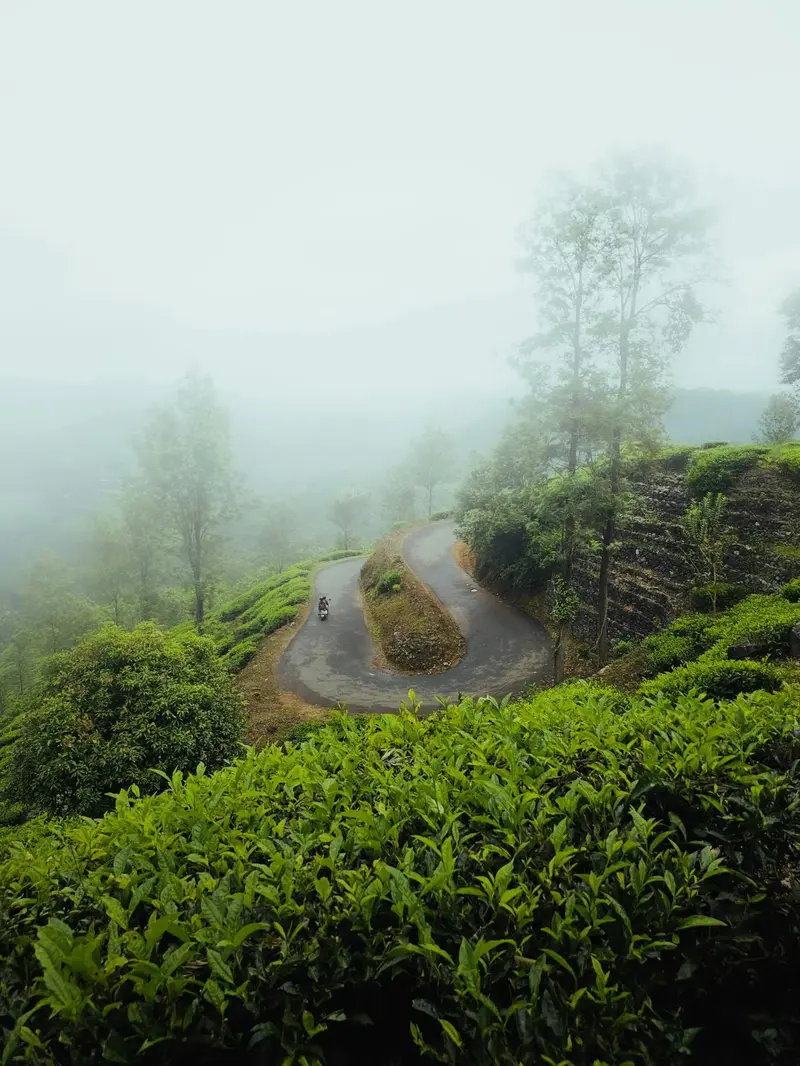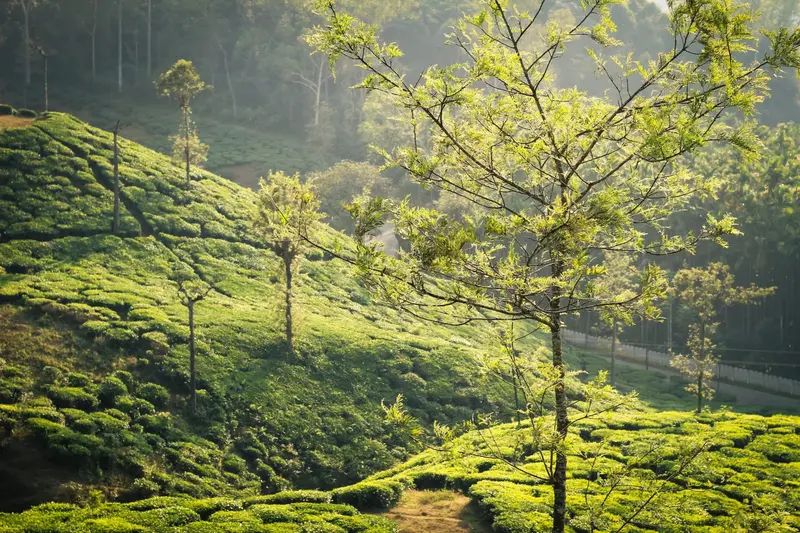
Munnar sits at 1,600 metres in the Western Ghats, where the Mudrapuzha, Nallathanni, and Kundaly rivers converge and the horizon in every direction is defined by rolling hills covered in tea. The name comes from this geography — Mun Aar, meaning "three rivers" in Malayalam. From a British tea planting station established in the 1880s, Munnar developed into the largest tea cultivation region in South India, covering over 33,000 hectares of the Idukki district's highlands.
The visual experience of Munnar is unlike any other hill station in India. Tea cultivation has shaped the landscape so completely and so uniformly — precise rows of clipped tea bushes following every contour, green on green on green from valley floor to ridge summit — that the effect is more like an infinitely detailed texture than an agricultural landscape. Against this green uniformity, the Eravikulam National Park introduces a different register: high Shola grasslands, vertical rock faces, and the Nilgiri Tahr (an endangered mountain goat) navigating slopes that no road reaches.
4.8 ★ Rated by 2.5L+ Travellers | Connect With An Expert
Best Time to Visit Munnar
Winter (October to February) is the peak season and the most consistently pleasant window. Temperatures between 5°C and 25°C, clear skies after the monsoon, and the full greenness of the post-rain landscape combine to create Munnar's finest conditions. The Eravikulam National Park is open and the Nilgiri Tahr are easily visible at close range on the plateau above the treeline.
Spring (March to May) is Munnar's second-best season — the air is slightly warmer, visibility is excellent, and the pre-monsoon months carry the full green of the tea gardens. This is the most comfortable period for the Anamudi summit approach (South India's highest peak, 2,695 metres) for trekkers with permits.
Monsoon (June to September) transforms Munnar into a different landscape — dramatic, dark, and extraordinarily green, with rainfall that fills every stream and creates waterfalls on slopes that are dry for eight months of the year. Most sightseeing spots remain accessible. Adventure activities are reduced, but the landscape rewards visitors who embrace wet weather. Hotel prices drop 40–50%.
Special: Neelakurinji Blooming (Every 12 Years)
The Strobilanthes kunthiana (Neelakurinji) flowers across the Munnar highlands every twelve years, covering the hillsides in blue-purple. The last major bloom was in 2018; the next is expected in 2030. If planning a Munnar trip within that window, plan around the bloom — it is one of India's most extraordinary natural events.
How to Reach Munnar
By Road
The Kochi to Munnar distance is 130 km, taking approximately 3.5 to 4.5 hours via the Adimali–Munnar road through the Periyar Tiger Reserve. This route passes through the Western Ghats on a road that climbs continuously from the Kerala plains to the high altitude — the change in vegetation and temperature is dramatic across the final 30 km. From Thekkady (Periyar Wildlife Sanctuary), Munnar is 100 km (3–4 hours) — a connecting route that allows combining both destinations in a single Kerala itinerary.
By Air
Cochin International Airport (COK) is the standard air gateway — 130 km from Munnar with a well-maintained highway approach. Multiple daily flights connect Kochi to Delhi, Mumbai, Bangalore, and Chennai, as well as direct international routes from Gulf countries serving Kerala's large diaspora community.
By Rail
Aluva (25 km from Kochi) and Ernakulam Junction (Kochi) are the nearest major railway stations. From either station, taxis and state buses complete the mountain approach to Munnar in 4–5 hours.
Local Cuisine to Try
Munnar's food culture is deeply rooted in Kerala's Malabar and Travancore traditions with the specific influence of the plantation community's cooking. Kerala Sadhya — the traditional ceremonial meal served on banana leaf, with rice, sambar, rasam, avial, thoran, and payasam — appears at festivals and in its best form at traditional family-run restaurants rather than tourist-facing venues. Appam with Stew (lacy fermented rice pancakes with a mild coconut milk vegetable or chicken stew) is the standard breakfast. Puttu and Kadala Curry (steamed rice cylinder with black chickpea curry) is the most authentic Munnar morning meal — available at every tea stall from 06:00. Fresh Munnar tea — consumed as the estate workers drink it, strong and sweet with full-cream dairy milk — is available from the KDHP factory shop and from the tea stalls around the Munnar bus stand.
Plan Your Munnar Journey
Let Himalayan Escalate help you plan a Munnar itinerary that combines the tea garden experience with serious wildlife encounters. Our Kerala team knows the permit system, seasonal conditions, and the properties that deliver the best plantation atmosphere.
Contact Us Today to start planning your Munnar trip!
---
Travel With Himalayan Escalate